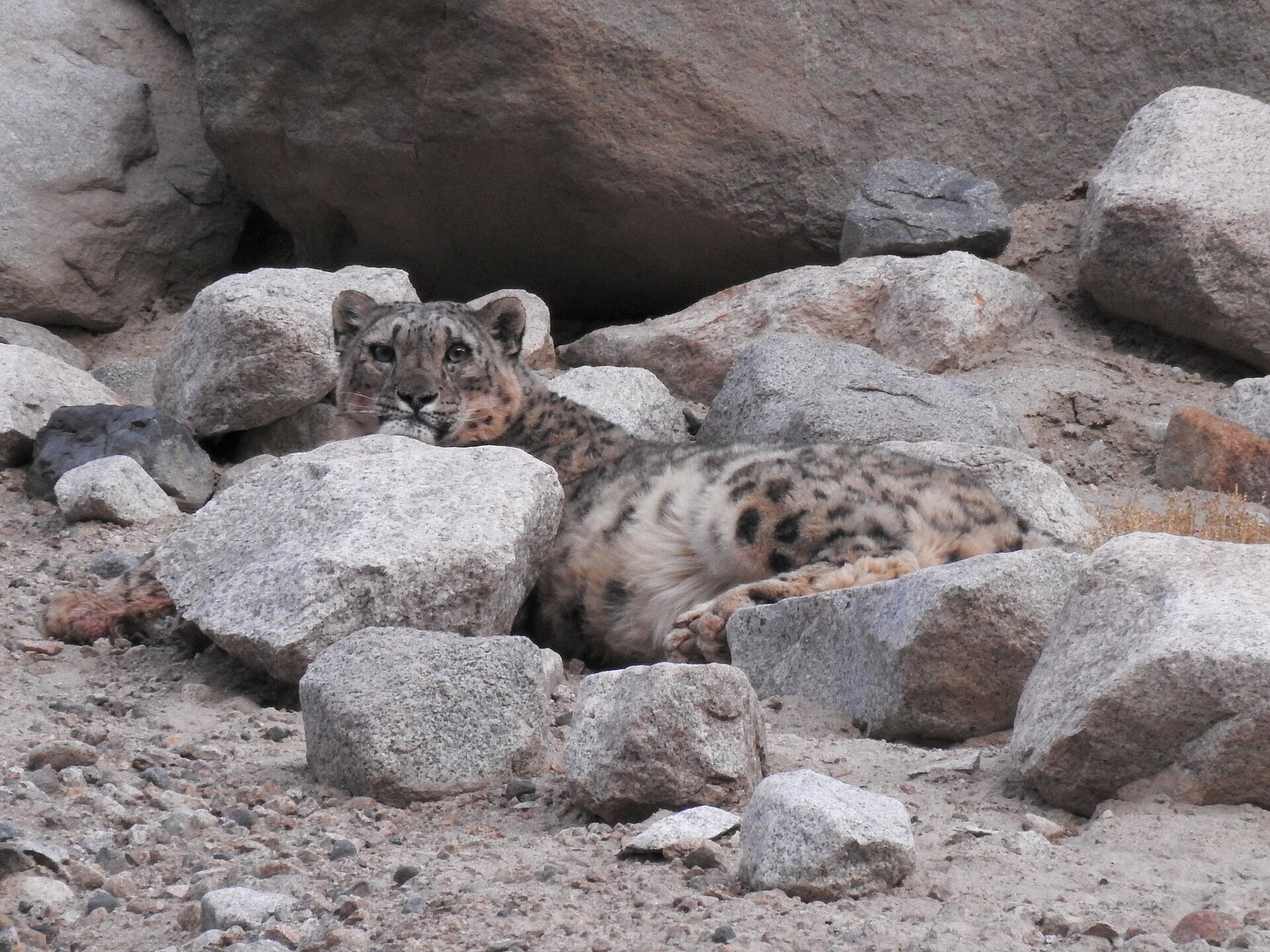
Photographing the shan, the snow leopard, in Hemis is mostly a story of distance and patience, not of exotic gear. Most sightings happen across a ravine, 150 to 400 metres away, through a spotting scope first and a camera second. The Ladakhi spotting teams who read the ridgelines before dawn do the real work: they find the animal, they judge the light, they tell you when to move and when to freeze. Your job is to have the camera ready when they do.
What lens actually gets the shot
At typical Hemis distances, anything under 400mm (full-frame equivalent) will give you a dot on a rock, useful for a trip record but not a print. A 500mm to 600mm prime, or a 150-600mm zoom, is the realistic working range for most visiting photographers. Teleconverters help on clear days but cost you a stop or more of light, which matters at dawn when the valley is still in shadow. A sturdy tripod with a gimbal or heavy ball head is not optional: at this focal length, handheld shots from a cold, tired arm rarely come out sharp. Weight matters too, since gear is often carried on foot or by pony for the last stretch into Rumbak or Husing.
Cold is a logistics problem
January and February temperatures in the Rumbak and Husing valleys regularly sit between -10°C and -20°C before sunrise. Batteries lose charge fast in that range: carry at least three for each body, keep spares inside an inner jacket pocket against body heat, and rotate them rather than waiting for one to die completely. Condensation on the lens when you step from a warm kitchen tent into the cold air is a bigger threat to a morning's shooting than the cold itself; let gear acclimatise inside a sealed bag for 20 to 30 minutes before bringing it out. Lens cloths freeze and become useless if damp, so carry two, one for use and one kept dry in an inside pocket.
Three charged batteries per body, a tripod rated for your lens weight, two dry lens cloths, and a chemical hand warmer taped near (not on) the battery compartment. Test the full kit at home in a freezer before the trip if you can.
Reading the light across the valley
The sun clears the ridgelines in Hemis later than you'd expect, often not reaching the valley floor until 8:30 or 9am in January. The hour before that is workable only with a fast lens (f/4 or wider) and high ISO, so expect to shoot at ISO 1600 to 6400 and accept grain as the price of a usable frame. Once direct light hits the slopes, contrast becomes the issue: a shan resting in sun against a shadowed rock face will blow highlights or lose the shadow side entirely. Spot metering on the animal, not the whole scene, and a touch of negative exposure compensation, around -0.3 to -0.7, generally keeps detail in the coat.
What the spotting teams can tell you that no gear can
A trained local spotter reads behaviour before most visitors notice anything at all: a shift in a blue sheep herd's grazing pattern, a raven circling a ridge, a particular fold in the rock that holds heat and therefore prey. These are the people who will tell you, quietly, to stay low and not change lenses mid-sequence because the sound carries. Trust their call on when to approach and when to simply wait where you are. Many of the best frames taken in Hemis each winter come from photographers who did nothing more than stay still for forty minutes on a spotter's instruction.
Settings worth trying before you leave home
Shutter speed matters more than most visitors assume: a resting shan barely moves, but a chasing or scent-marking animal needs at least 1/1000s to avoid blur at long focal lengths. Continuous autofocus with a single, narrow point (not the full-area mode) tracks better across cluttered scree than a wide zone, which tends to lock onto rock texture instead of fur. Shooting in RAW rather than JPEG gives real recovery room for the contrast problems described above, and a formatted, fast memory card (UHS-II if your body supports it) avoids buffer lag during a short burst, which is often all you get.
Etiquette that protects the sighting for everyone
Noise and movement at a scope line will end a sighting faster than any animal's own caution. Keep conversation to a whisper, change lenses or settings before the spotter calls an animal rather than during, and never move position without a nod from the local team. Group sizes at a single viewpoint are usually kept small by the homestay or guide coordinating the trip, partly for exactly this reason. A quiet, disciplined group that gets twenty minutes of calm observation will come away with better images than a noisy one that gets five.
None of this guarantees a photograph. Some winters bring three sightings in ten days, others bring one in three. What the gear and the discipline buy you is readiness: when the spotting team's hand goes up, you want your exposure already close, your tripod already level, and your breathing already steady. The wonder, when it comes, happens at the eyepiece, not in the kit bag.