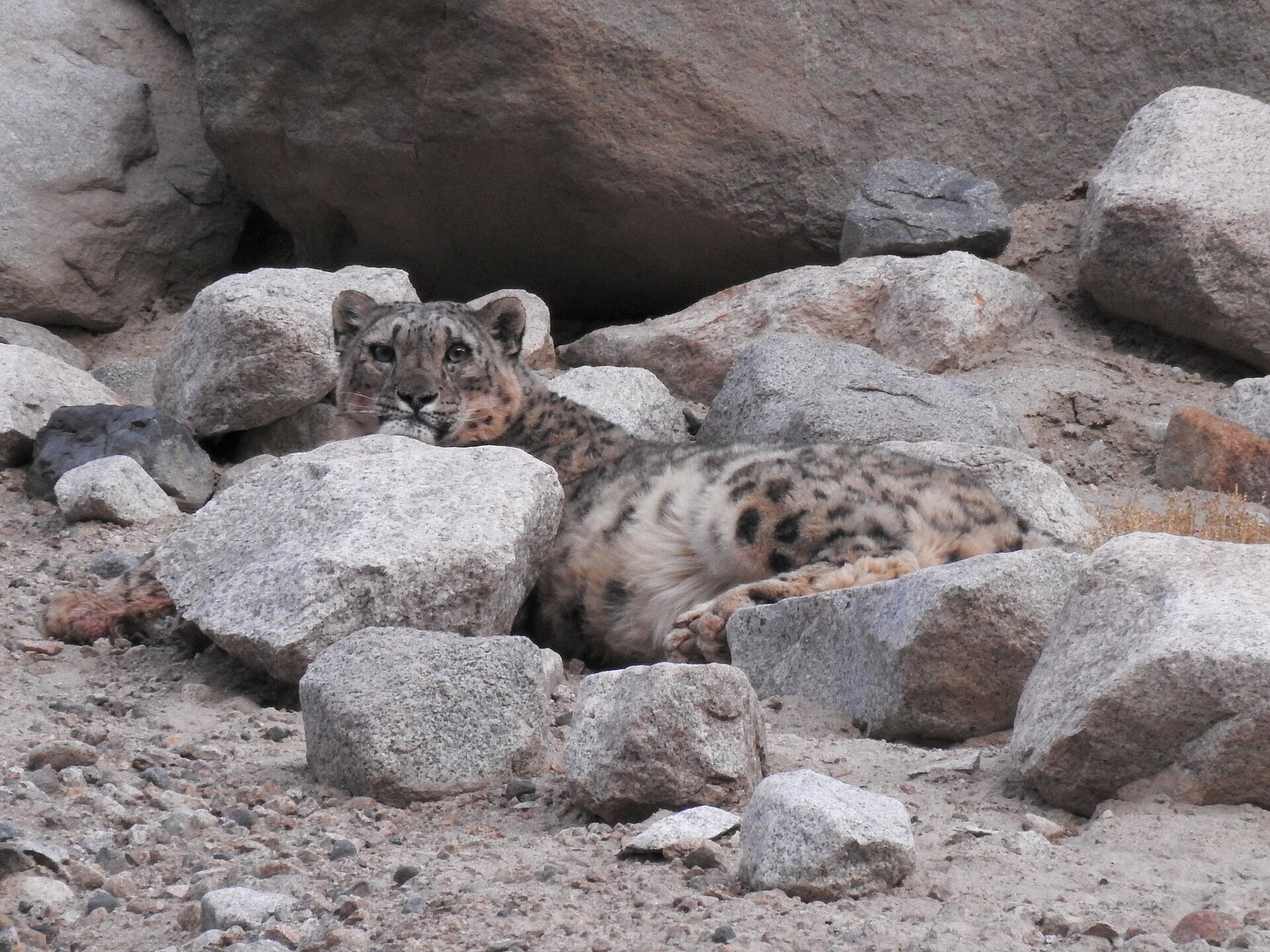
Hemis National Park runs on two calendars that barely overlap. One belongs to the snow leopard, which comes down into reach of spotting scopes only when its prey does, in the depth of winter. The other belongs to trekkers and the Hemis Festival crowd, who need bare trails and open high passes, available only in summer. Picking "the best time" really means picking which version of the park you want to see, because the two rarely coincide.
Winter (late December to early March): snow leopard odds
This is when Hemis earns its reputation. Blue sheep (bharal) descend to lower slopes to feed, and snow leopards follow them down into side valleys like Rumbak and Husing, bringing cats within range of a spotting scope for the first time all year. Daytime temperatures in these valleys, at 3,800 to 4,200 m, sit between -5°C and -15°C; nights regularly drop past -20°C. This is logistics, not atmosphere: down to -30°C-rated sleeping bags, four layers on the legs, chemical hand warmers that actually work, and a flask that does not freeze shut by 10 a.m. None of this guarantees a sighting. Ladakhi spotting teams, who read fresh tracks, listen for alarm calls from the local ibex and bharal, and know which ridge a particular cat favours this week, are doing the real work; visitors are mostly there to wait with good optics and reasonable layering. For a frank account of what a sighting actually takes, and what it does not, see the snow leopard trip, honestly. Roads from Leh to Rumbak and Zingchen stay open but icy; check conditions before committing to a date, and read routes and times from Leh in advance.
Leh sits at 3,500 m. Arriving from sea level and heading straight into the park risks altitude sickness, which ruins more winter trips than cold does. Spend at least two full days in Leh before any trek or spotting excursion; see the acclimatisation routine that saves your trip.
Spring (March to May): transition, thinner crowds, mixed odds
By late March the heaviest snow in the valleys is retreating and blue sheep start moving back up, taking the snow leopards with them. Odds of a sighting in April and May drop noticeably compared to January and February, though they do not vanish; some homestay hosts report cats still working lower ground into early April in colder years. Daytime temperatures climb to 0°C to 10°C, nights still freeze. This is a reasonable window for travellers who want milder cold with some residual winter wildlife chance, and for photographers: softer light, less dust in the air than high summer, and still-bare branches. For camera settings and gear suited to the cold end of this window, see long lenses at -15°C.
Summer (June to September): trekking season
This is when Hemis opens up for walking. Snow clears from the high passes (Ganda La, Kongmaru La) by mid-June in most years, and the Markha Valley trek becomes fully walkable through to late September. Daytime temperatures in the valleys reach 15°C to 25°C; nights are cool but not punishing, typically 2°C to 8°C at altitude. This is also monsoon season on the Indian plains, but Ladakh sits in a rain shadow, so expect dry trails with occasional short showers rather than sustained monsoon weather. For the full route broken into stages, distances, and camp options, see the Markha Valley trek, stage by stage. Snow leopards are present year-round in the park but are far harder to spot in summer: ground cover is thicker, prey is dispersed across higher pasture, and cats are not forced down by hunger the way they are in January.
The Hemis Festival: a fixed date, not a season choice
The Hemis Festival, with its masked Cham dances at Hemis Gompa, usually falls in June or July, timed to the Tibetan lunar calendar rather than a fixed Gregorian date; check the current year's schedule before booking flights. It draws the largest crowds the park sees all year, and accommodation in Leh and near the monastery should be arranged well ahead. This is not a wildlife trip: it is a cultural one, and the two rarely combine, since summer is the weakest window for leopard sightings. Details on the dances and what to expect are in the Hemis Festival guide.
Choosing a base by season
Where you stay should follow what you are there for. In winter, villages closer to known spotting valleys (Rumbak, Ulley) cut daily travel time and let spotting teams start before dawn, when cats are most active. In summer, Leh itself works better as a trekking base, with easier resupply and transport to trailheads. A full comparison of these options, with realistic distances and what each place actually offers, is in where to stay for snow leopards. Whichever base you choose, homestays are often the only lodging option in smaller villages, and basic courtesy matters more than in a hotel; see homestay etiquette at 3,800 m before arriving.
Permits and fees: check before any season
Entry fees and permit requirements for Hemis National Park apply regardless of month, though office hours and processing can slow down around festival dates or deep winter when staff numbers drop. Budget for park entry fees in the range of a few hundred rupees per day for foreign nationals, plus separate camera or trekking permit charges depending on your route. Exact current figures and where to obtain permits are listed in the entry fees and permits guide, worth reading before finalising dates in any season.
A short answer, if pressed
For snow leopards specifically, late December through February gives the strongest odds, accepting serious cold as the cost of entry. For trekking the Markha Valley and the high passes, June through September is the only realistic window. For the festival, go when the lunar calendar sets it, usually midsummer. There is no month that does all three well, and claiming otherwise would not survive a single January night in Rumbak.